Biography
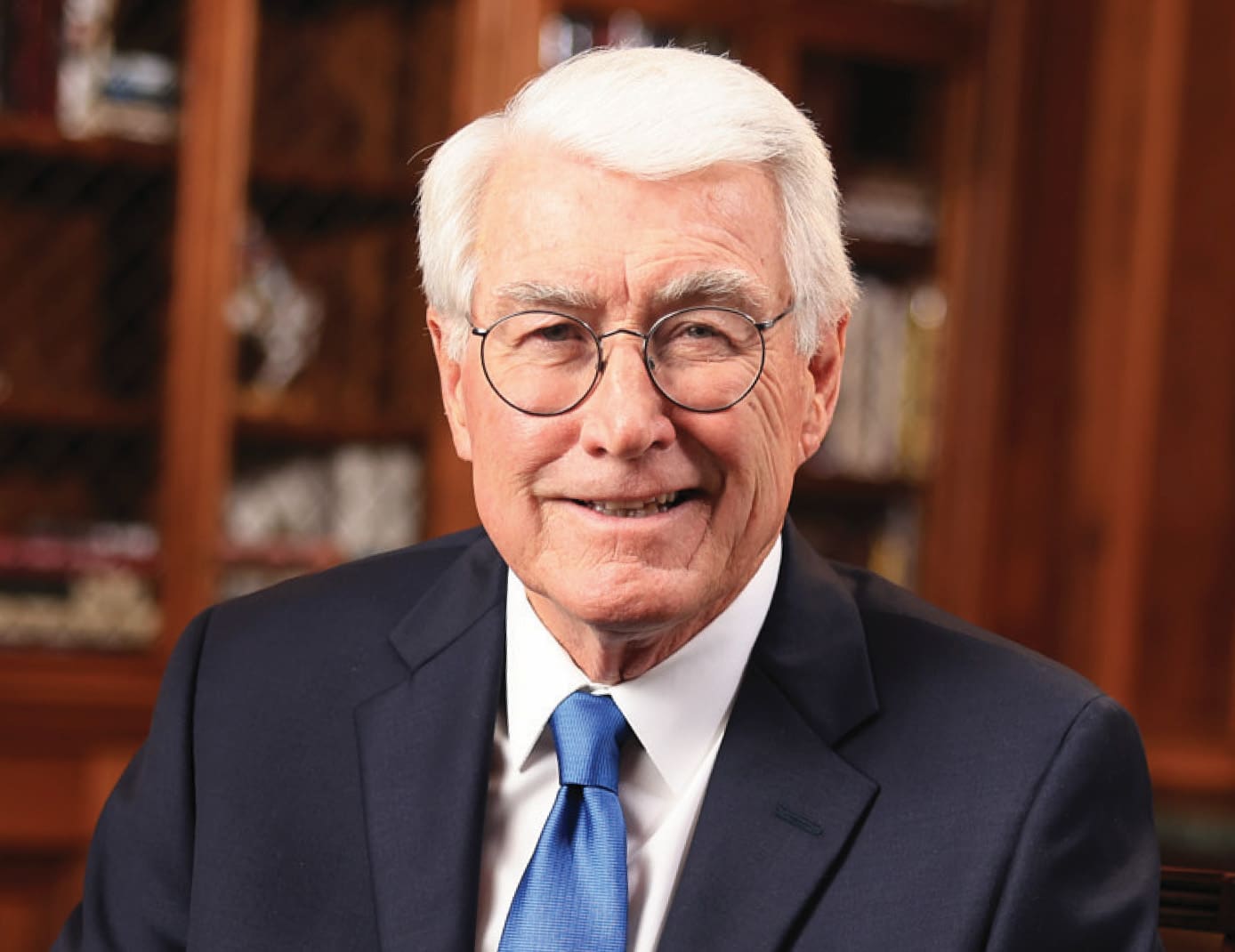
Governor Jim Edgar (July 22, 1946 – September 14, 2025) served as the 38th Governor of Illinois and was widely regarded as one of the state’s most respected and effective public servants. Throughout more than three decades in public office, he earned a reputation for integrity, fiscal responsibility, bipartisan leadership, and an unwavering commitment to serving the people of Illinois.
As governor, Edgar inherited what was then the largest budget deficit in Illinois history. During his two terms, he implemented hundreds of millions of dollars in budget reductions, streamlined state government by reducing the workforce by more than 2,500 positions, eliminated a $1 billion backlog of unpaid health care bills, provided income tax relief, and left office with an unprecedented $1.5 billion budget surplus for his successor.
He reformed welfare by helping families move from dependence to independence, successfully championed property tax caps that saved Illinois homeowners billions of dollars, and secured legislation establishing an adequate funding level for every child attending Illinois public schools. Governor Edgar and First Lady Brenda Edgar also received national recognition for transforming Illinois’ adoption system, moving the state from one of the nation’s lowest-performing to one of its highest in placing children into permanent, loving homes.
Elected governor in 1990, Edgar was re-elected in 1994 by the largest plurality ever received by an incumbent Illinois governor, carrying 101 of the state’s 102 counties, including Cook County. Although enjoying record-high approval ratings, he surprised political observers by announcing he would not seek a third term.
His accomplishments as governor built upon an already distinguished tenure as Illinois Secretary of State, where he led the state’s crackdown on drunk driving, created a nationally recognized adult literacy program, and successfully fought for legislation requiring motorists to carry automobile insurance.
Upon leaving office, the Chicago Tribune observed that Edgar’s “instincts and motives were as sound as those of any governor the state has had,” while the Peoria Journal Star praised his “firm, competent, keeping-the-lid-on management.”
Following his retirement from elected office, Governor Edgar continued to dedicate himself to public service. He served as a Resident Fellow at Harvard University’s John F. Kennedy School of Government before becoming a Distinguished Fellow at the University of Illinois Institute of Government and Public Affairs. He founded the Edgar Fellows Program, a bipartisan leadership initiative that brings together emerging leaders from across Illinois to foster civility, compromise, and collaboration in addressing the state’s most pressing challenges. He also lectured at universities throughout Illinois, served on numerous corporate and nonprofit boards, and was President Emeritus of the Abraham Lincoln Presidential Library Foundation.
Governor Edgar’s administration achieved landmark progress across numerous policy areas. Education funding for kindergarten through twelfth grade increased by nearly $2 billion during his administration, including the nationally acclaimed 1995 reforms of Chicago Public Schools. His administration overhauled Illinois’ child welfare system, tripled spending to protect abused children, significantly increased adoptions, expanded health care coverage for working families, implemented sweeping welfare reforms, and helped nearly 200,000 families move from welfare to work.
His economic leadership guided Illinois through the recession of the early 1990s, resulting in more than 600,000 new jobs and the state’s lowest unemployment rate in nearly three decades. His conservation efforts earned him the nickname “The Conservation Governor” and the Nature Conservancy of Illinois’ Lifetime Achievement Award for preserving more open space than any previous administration while balancing environmental stewardship with economic growth.
Nationally, Governor Edgar served as President of the Council of State Governments, Chair of the Education Commission of the States, Chair of the Midwest Governors’ Association, Chair of the Governors’ Ethanol Coalition, and held numerous leadership positions within the National Governors Association.
His public service began in 1968 as a legislative aide in the Illinois General Assembly. After serving as Director of State Services for the National Conference of State Legislatures, he was elected to the Illinois House of Representatives in 1976. Governor Jim Thompson later appointed him Illinois Secretary of State, a position to which he was elected in 1982 and re-elected in 1986 by the largest plurality ever received by a statewide candidate.
Born in Vinita, Oklahoma, Governor Edgar moved to Illinois as a child, grew up in Charleston, graduated from Charleston High School, and earned a bachelor’s degree in history from Eastern Illinois University, where he served as student body president.
Governor Edgar passed away on September 14, 2025. His passing prompted an outpouring of tributes from leaders across the political spectrum, who remembered him as one of the most trusted, respected, and admired elected officials in Illinois history. He was widely praised for his uncommon ability to put principle before politics, build bipartisan consensus, govern with humility and integrity, and always place the interests of Illinois families above partisan interests. His legacy of civility, compromise, compassion, and public service continues through the countless leaders he mentored and the enduring impact of the Edgar Fellows Program.
Governor Edgar and his wife, Brenda, were the proud parents of two children, Brad and Elizabeth, grandparents of five grandchildren, and great-grandparents of one great-grandchild.